Competitor Ad Research With an MCP Server: What a Real Run Gets Wrong
We asked an AI agent which brands run Black Friday ads now. 2 of its top 20 still were. The four checks that turned 100 rows into 17 live ads.
At 6 a.m. UTC on 11 November 2026, sixteen days before Black Friday, we gave an AI agent connected to the Brandsearch MCP server one question: which ecommerce brands are running Black Friday ads on Meta right now, and which ones are the biggest?
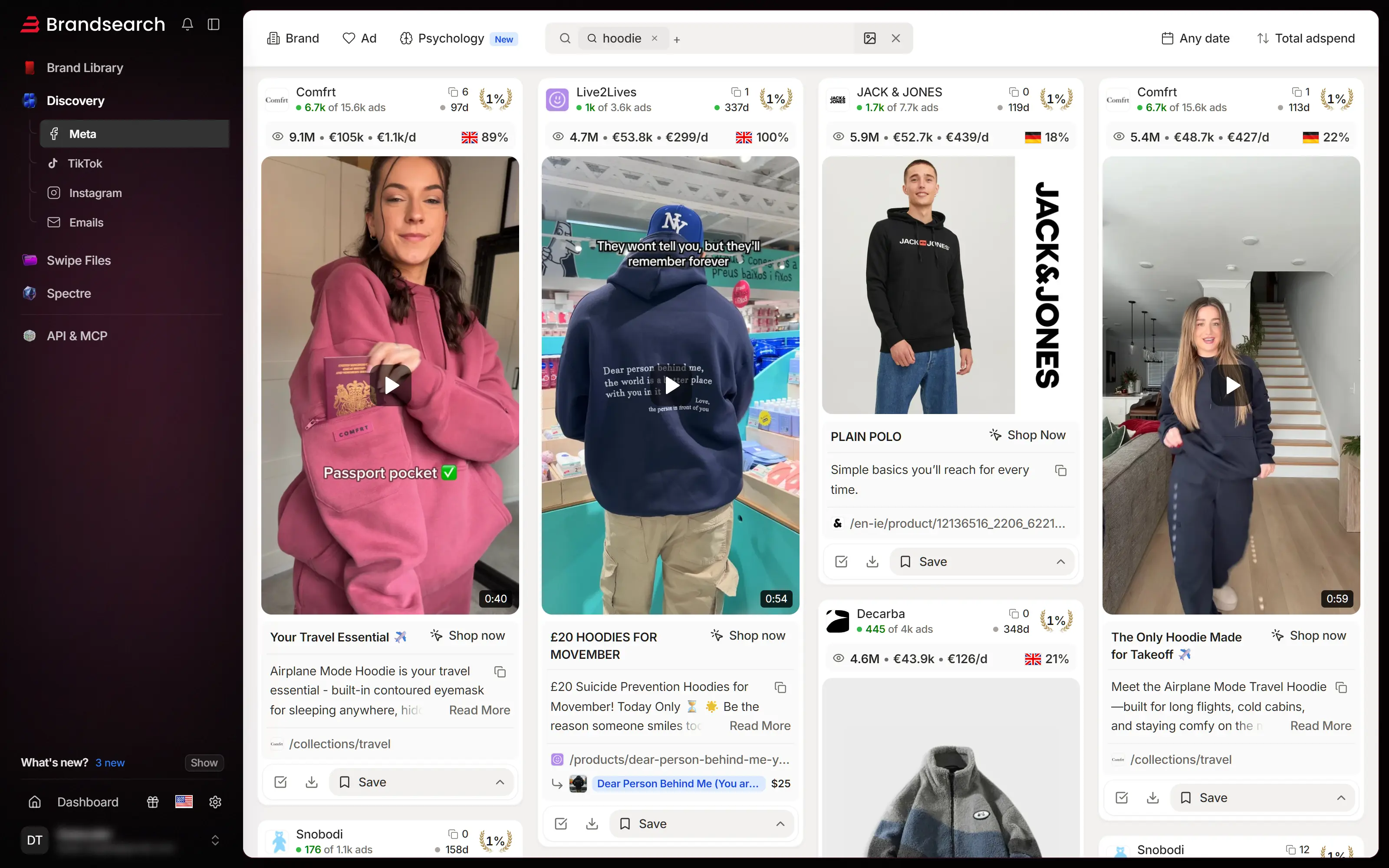
The agent did what any agent does. It called the ad search with q="black friday", status="active", ads started since 15 October, English, sorted by EU reach, and came back within seconds with a confident table: Bambu Lab's 3D printer sale at 6.3 million people reached, two Italian canvas-print shops at 1.8 and 1.4 million, AYBL's "up to 60% off" early-access ads, Drool's art prints. It added that 186,249 ads matched.
Almost none of that was true in the way the question meant it. Of the first 20 rows, 2 were ads still running that morning. This guide is the four checks that got us from that first answer to a list we would act on, with the numbers from the run, so you can set up the same thing in Claude, Cursor or any client that speaks MCP.
What the first answer got wrong
An ad search returns ads that match the filters. status=active means the ad was active the last time the index saw it, and for most rows the last time was days or weeks ago. The query never asks when.
We pulled the top 100 rows of that same search and looked at three fields the agent had not printed: the ad id, the brand domain and end_date, which for an active ad is the last day it was seen running.
Source: Brandsearch, Meta ads index (query_meta_ads, q=black friday, status=active, started from 15 Oct 2026, English, sorted by EU reach) · Data as of November 11, 2026
The figures
| Name | Unique ads |
|---|---|
| 0-3 days | 19 ads |
| 4-7 days | 21 ads |
| 8-14 days | 27 ads |
| 15-21 days | 13 ads |
The median ad in that list had last been seen 8 days earlier. Only 19 of 80 had been seen in the past three days. The top row, Bambu Lab's sale announcement with the largest reach in the set, ran from 22 to 24 October. It is a fine example of a big Black Friday teaser. It is not something a competitor is paying for this week.
The 186,249 figure fails the same way. It counts every match the index has ever marked active, not ads in flight. An agent will quote it as "186,000 Black Friday ads are running", and a reader will repeat it.
Step 1: Make the agent return the dates and the id
The fix starts in the request, not in the analysis. Ask for id, brand_id, start_date, end_date, status and eu_total_reach on every row, and tell the agent it may not call an ad live until it has looked at end_date. Without the fields in the response, the model has nothing to check against and fills the gap with the word "active".
Ask for 100 rows, not 20. You are about to throw most of them away.
Step 2: One ad, one row
AYBL took up six of the first twenty rows. They were two ads, each listed under nl.aybl.com, ca.aybl.com and de.aybl.com, with slightly different reach figures on each copy: 1,245,026, 1,245,024 and 855,185 for the same image ad. Velites Sport appeared under four domains. In total, 20 of the 100 rows were repeats, and 14 ads sat under more than one domain.
Brandsearch attaches an ad to each storefront domain of the brand that ran it, which is right for brand pages and wrong for a leaderboard. Deduplicate on the ad id before you count, rank or add anything up. Summing reach across the top 20 rows gave 22.4 million people; after deduplication it was 18.0 million. The ad search's max_ads_per_brand setting does not prevent this, because each domain counts as its own brand.
Step 3: Keep only ads seen in the last three days
Of the 80 distinct ads, 19 had an end_date on or after 8 November. That three-day window is the rule we use on this blog for "still running" and it is deliberately strict: Brandsearch's index was refreshed at 05:44 UTC that morning, so a live ad should show a sighting from the last day or two.
The search has no filter on end_date. The agent has to filter after the fact, which it will do reliably once you say so and never if you don't.
Step 4: Re-open every survivor
The search result is a copy. The ad's own record is the one to trust. We called get_meta_ad on each of the 19 ads.
Two of them, both AYBL, had flipped to inactive. Their copy announced an early-access sale opening on Monday 9 November at 7 p.m. GMT; the ads stopped the same day, and the copies listed under the country domains still said active.
The re-check also returned figures that had moved on: Charmsoff's bracelet ad went from 392,676 people reached in the search row to 411,828 on its own record. Quote the re-checked number, with the day you pulled it.
Source: Brandsearch, Meta ads index (query_meta_ads then get_meta_ad on each survivor) · Data as of November 11, 2026
The figures
| Name | Count |
|---|---|
| Rows returned | 100 |
| Distinct ads | 80 |
| Seen in last 3 days | 19 |
| Active on re-check | 17 |
| Brands | 10 |
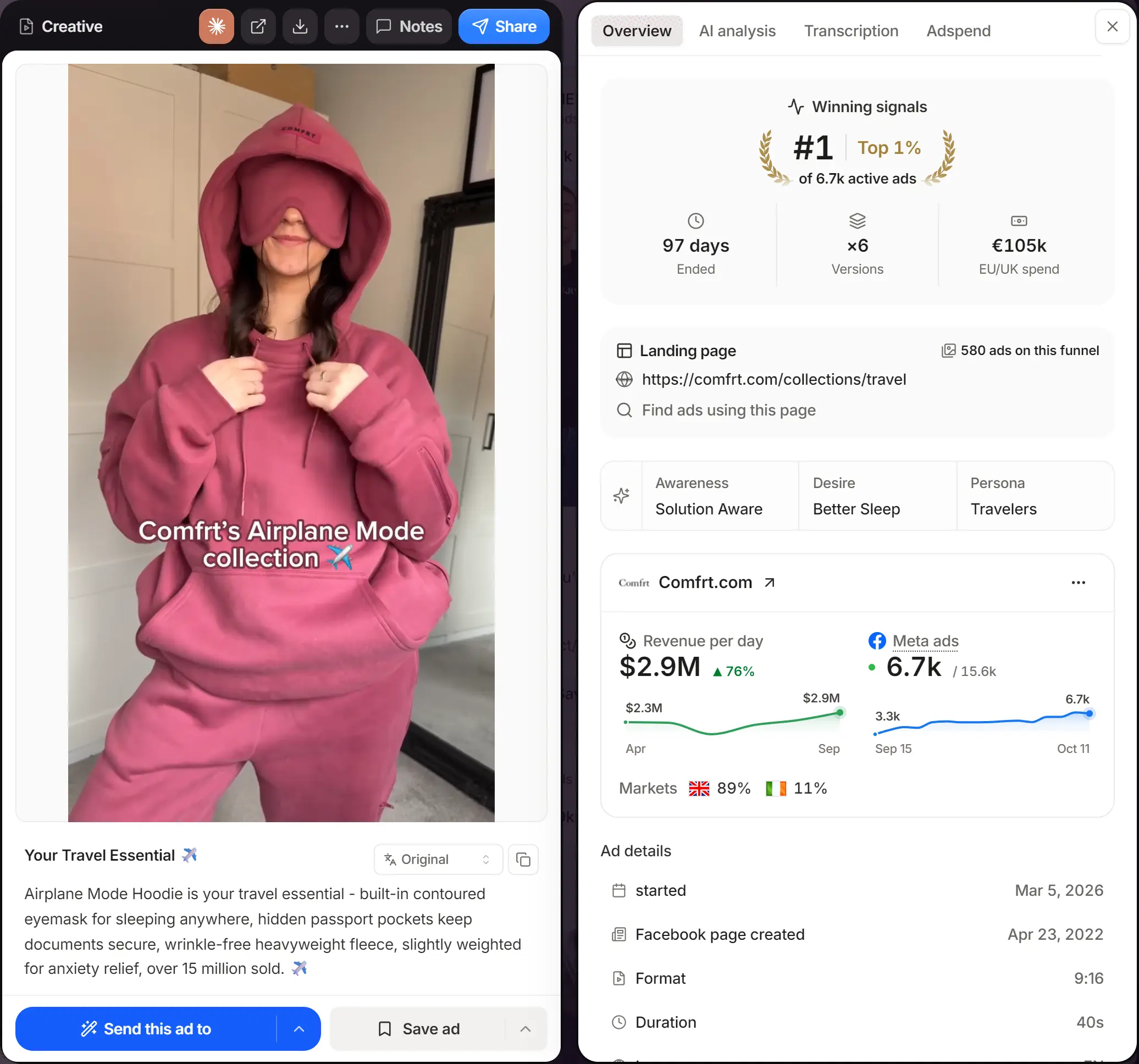
Seventeen ads from ten brands. Of the top 20 rows the agent first showed us, two survived: Airback's "up to 70% off + free shipping" video, which began on 6 November, and an FGM04 leggings video, which began on 4 November.
Stop reading about winners. Find them yourself.
Search 15M+ brands, their ads, revenue, and products — all in one place.
Try Brandsearch freeWhat the ten brands are doing, sixteen days out
Once the list is real, it says something the first one couldn't. Ten of the 17 live ads carry an offer today: Charmsoff at "up to 70% off everything" on three image ads, Hallmark UK at "up to 40% off selected lines" on two videos since 30 October, Evolution Power Tools with "Black Friday starts now" and a free second blade, JRS Industrial with a £99 workwear bundle for businesses, Geeks Outfit with "buy 3, get 10% off". FGM04's leggings video names Black Friday without stating an offer.
Five ads ask for nothing but an email address. Art by Maudsch runs four versions of the same "Black Friday early access, sign up to our VIP list" image; Represent's copy reads "Black Friday sale is coming soon. Sign up now. 18.11.26." One ad, Shelly's, sells no deal at all: it points to a "top 10 smart home devices to watch this Black Friday" page.
If you sell in any of these categories, that split is the useful part. The brands paying for reach this week are mostly selling now, two and a half weeks early, rather than building a list for the day itself. It fits the pattern in the Black Friday ads that started in September, and it is the kind of conclusion the unfiltered table would have got wrong: AYBL's early-access campaign looked like the biggest live play in the set and had already ended.
A sample of 17 ads proves nothing about the market as a whole. It does tell you who to watch, and that is all the agent was asked.
Three numbers the agent will misread anyway
Spend. The search row printed "EU Spend: €34,391" for Bambu Lab, and an agent left to itself reports that as money spent. eu_total_spend is Brandsearch's estimate: the reach Meta publishes for the EU, multiplied by a fixed rate per country. It is useful for comparing ads on one scale. It is not what the advertiser paid, and ranking by it is ranking by reach in different units. Make the agent label it "estimated" every time. Our explainer on Meta Ad Library reach covers what the reach figure itself counts.
Reach. It is people in the EU, because that is where Meta publishes the figure. A US-only campaign can show tiny or no EU reach and still be large. Airback's ad record carried no reach figure at all at re-check time, although the search row had one; a blank is missing data, not zero.
Totals. Any count the search returns ("186,249 matches") is a count of index rows, duplicated across domains and spread over weeks. It is not a count of ads running. If you need a market-wide number, compare shares of the index over the same window, never raw counts across years.
The instruction block we now paste first
Agents follow constraints they are given at the start more reliably than corrections later. This is the block we put at the top of any ad-research session over MCP:
When you report Meta ads as "running" or "live":
1. Request id, brand_id, start_date, end_date, status, eu_total_reach on every row.
2. Deduplicate by ad id before counting, ranking or summing.
3. Keep only ads whose end_date is within the last 3 days of today's date.
4. Re-open each kept ad with get_meta_ad; drop any that are no longer active,
   and quote the figures from that call, with the date.
5. Call eu_total_spend "estimated spend". Never call it disclosed or actual.
6. Never present a search total as a count of live ads.
Show me how many rows each step removed.
The last line matters most. When the agent reports "100 rows, 80 distinct, 19 recent, 17 confirmed", you can see at a glance whether the answer rests on two ads or two hundred.
The same workflow runs in the Brandsearch app by hand, and through the MCP server from your own agent. If you want ready-made lists that have already been through these checks, the monthly Facebook ad examples still running series applies the same three-day rule.