Meta Ad Library Reach: What the Number Means and What a Big One Looks Like
What EU reach in the Meta Ad Library counts, what it leaves out, and where a reach figure ranks against 1.47 million e-commerce ads from 2026.
On 23 June 2026, Ring ran a video ad that sent shoppers to its Amazon store page. Meta's Ad Library credits it with 12,345,835 people reached in the EU. It ran for about a day. Since 1 January, a tabletop-projector ad from mycozytime.com has been in the same library, still being served on 22 October. Its EU reach is 953.
Run time and reach point in opposite directions here. Only one of them is a number Meta publishes. This piece explains what that number counts, what it leaves out, and what a "big" reach figure looks like once you set it against 1.47 million e-commerce ads.
What Meta is counting
For any ad delivered in the European Union, the Ad Library publishes an estimated total reach. Meta's API documentation describes the field (eu_total_reach) as "the estimated combined ad reach for all locations inside the European Union", available only for ads delivered to the EU. The EU's Digital Services Act requires that transparency. It applies to every commercial ad shown there, not only political ones.
Three things follow from that definition, and most guides get at least one of them wrong.
Reach is people, not impressions. It counts accounts that saw the ad at least once. Meta now counts Accounts Center accounts, so one person with linked Facebook and Instagram profiles counts once. An ad shown five times to the same shopper adds one to reach. Frequency is not published.
Reach is an estimate, and Meta revises it. Chāmpo's "For Thicker, Fuller Hair" ad appears in the Brandsearch index under three of its storefront domains, each captured on a different day. The figures read 14,465,090, then 14,435,831, then 14,388,876. That is a 0.5% gap between the highest and lowest, and the later figures are not always the higher ones. Treat the last digits as noise.
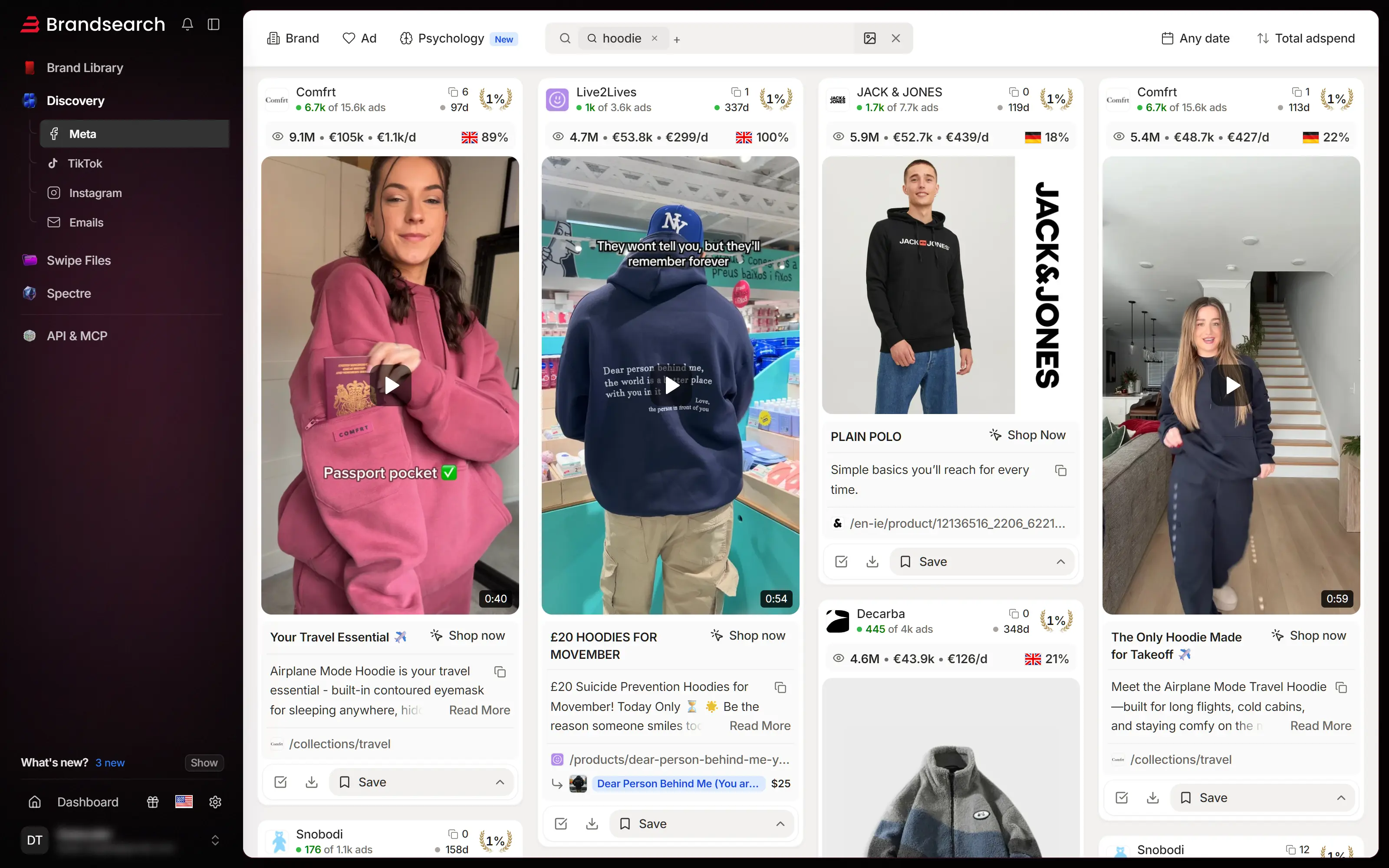
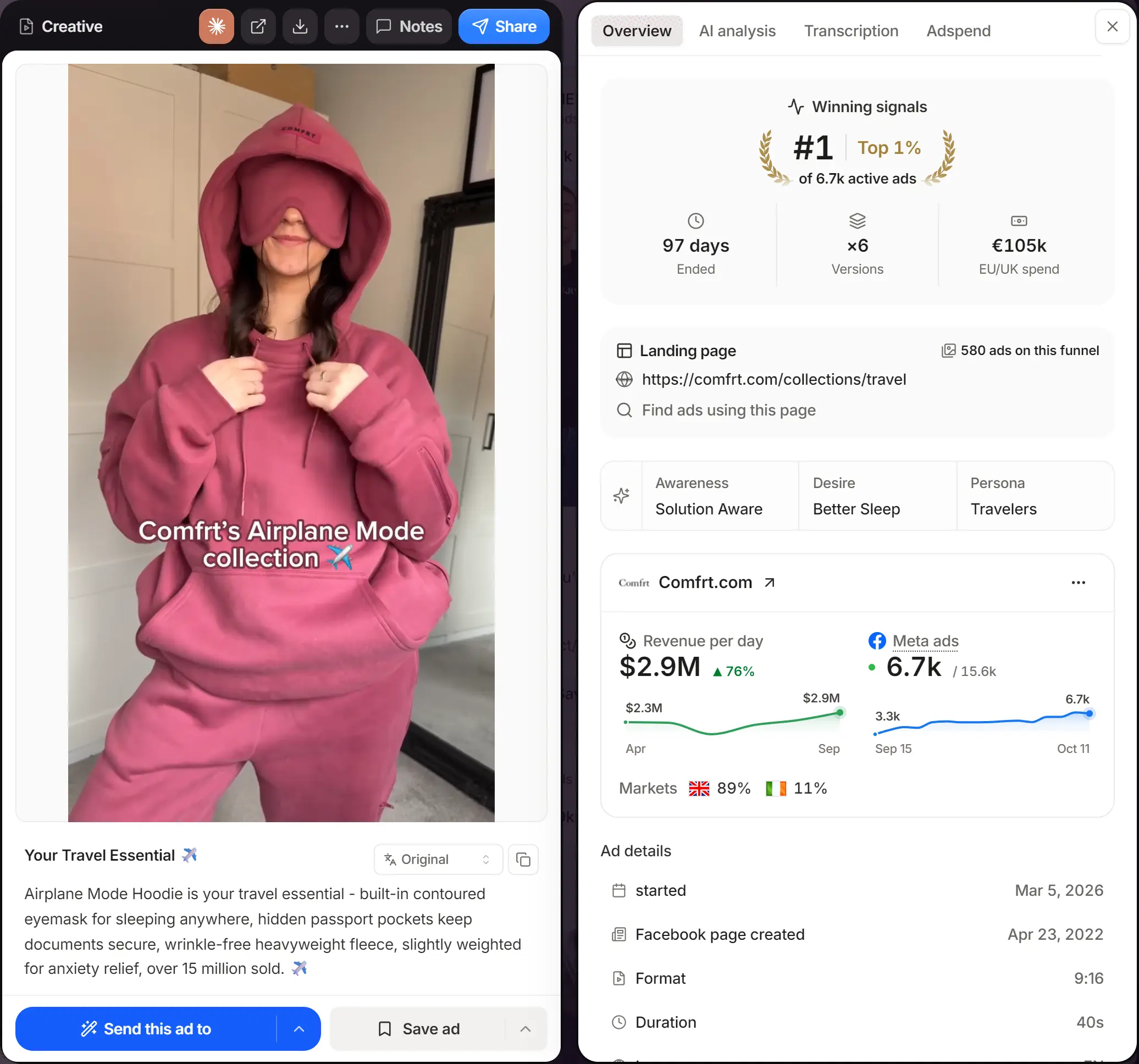
Reach exists only where the ad ran in the EU. Of the 4,084,807 ads launched by Shop Pay stores between January and June 2026, 64% carry no EU reach at all: Meta has no EU delivery on record for them. For an ad that runs only in, say, the US, the library shows the creative and the dates, and nothing else. If a competitor sells only in North America, the Ad Library will never tell you how hard they push an ad.
The scale: what 1,000 or 100,000 people actually means
Without a reference point, a reach figure means little. 40,000 sounds like a lot until you know where it sits. So here is where it sits, for the 1,470,459 ads from Shop Pay stores that launched in the first half of 2026 and reached anyone in the EU.
Source: Brandsearch, Meta ads index, ads from stores using Shop Pay, started 1 Jan to 30 Jun 2026, EU reach of at least 1 · Data as of October 26, 2026
The figures
| Name | Share of ads |
|---|---|
| 1-99 | 13.5% |
| 100-999 | 19.9% |
| 1k-3k | 13.2% |
| 3k-5k | 6.9% |
| 5k-10k | 9.7% |
| 10k-50k | 20.5% |
| 50k-100k | 6.4% |
| 100k-300k | 6.3% |
| 300k-1M | 2.8% |
| 1M+ | 0.7% |
The median ad reached between 3,000 and 5,000 people. One in three never reached 1,000. Every ad that crosses a threshold also crosses the ones below it, which gives you a ready reckoner:
| EU reach of the ad | Share of ads at or above it | Roughly |
|---|---|---|
| 1,000 | 66.6% | two in three |
| 10,000 | 36.8% | one in three |
| 50,000 | 16.2% | one in six |
| 100,000 | 9.8% | one in ten |
| 300,000 | 3.5% | one in 29 |
| 1,000,000 | 0.69% | one in 145 |
When you open a competitor's ad and see 120,000, that ad is in the top tenth of everything Shop Pay stores launched in the first half of this year. At 1.2 million it is in the top 1%. Those are the ads worth copying the structure of. An ad at 2,000 is not a failure, but it tells you nothing about what works. It is almost always a test, or a variation the algorithm stopped favouring.
Most competitor research skips this step. Someone screenshots an ad because it has been "running for months" and builds a brief around it. The reach figure would have shown it was one of the 33% that never found 1,000 people.
Stop reading about winners. Find them yourself.
Search 15M+ brands, their ads, revenue, and products — all in one place.
Try Brandsearch freeRun time is the weaker signal
That brings us back to the two ads at the top. The mycozytime.com projector ad started on 1 January 2026, was still being served on 22 October, and had reached 953 people in the EU. That is 294 days at about three people a day. By the "long-running ads are winners" rule that many ad-spy tutorials teach, it is a ten-month winner.
It isn't a winner, at least not in Europe. An ad can stay "active" for months with a budget of a few euros, or as a leftover in an ad set nobody has switched off. The Ring ad did the opposite: twelve million people in a single burst, then off. Run time measures how long an ad was allowed to exist. Reach measures how much delivery it got.
Run time still has one use. Divide reach by days live and you get a pace, and pace separates the forgotten ad from the scaled one. Two ads at 300,000 people are not the same if one got there in a week and the other in eight months. We covered how to tell an ad that is being scaled from one that is just running in more detail.
Why "estimated spend" tells you nothing reach doesn't
Every ad-spy tool, Brandsearch included, shows a euro figure next to EU ads. Meta does not publish spend for commercial ads. That figure is calculated: reach multiplied by a fixed rate per country.
You can see the arithmetic in the numbers. The Ring ad shows €141,977 against 12,345,835 people: €11.50 per thousand. Chāmpo's shows €166,348 against 14,465,090: €11.50 again. The mycozytime ad shows €10.96 against 953 people: €11.50. SKIMS's bralette ad comes out at €9.24 per thousand, and the difference comes only from which EU countries it reached.
So the spend column is reach converted into euros. It adds no new information, and it is not what the advertiser paid: the real price depends on the auction, and nothing in the Ad Library shows it. Use it to talk about scale in money terms if that helps a client meeting, but sort and filter on reach. Never read spend divided by reach as a CPM. It only returns the rate the estimate was built with.
That cuts against a common pitch, ours included, so it is worth saying plainly: the hard number in the Ad Library is reach. Everything else is either the creative, the dates, or a model built on reach.
Reading a competitor's ad account with this in mind
A few habits change once reach is the number you trust:
- Rank a brand's ads against each other first. Sort its ads by reach before you read any of them: the top few are its current bets, the long tail is testing. In Gisou's 2026 Meta history, the brand's most-reached ad of the year, launched in January, reached 2.81 million people on its own.
- Use the thresholds above as a filter. If you only study ads above 100,000 EU reach, you discard about 90% of the library and keep the ones Meta's delivery actually backed.
- Check twice, a week apart. Apart from small revisions, reach climbs only while an ad is delivering, so an ad that gained 200,000 people in seven days is live and funded, whatever its status label says. A status of "active" on its own is often stale.
- Accept the blind spot. No EU reach does not mean small. It means not in Europe. For US-only brands, ad count and new-ad velocity are the fallback, and they are much weaker.
If you want to apply the 100,000 filter across a whole niche rather than one brand at a time, Brandsearch sorts every indexed Meta ad by EU reach. Our monthly Facebook ad examples still running are built the same way.
How these figures were built: counts come from the Brandsearch Meta ads index, pulled on 26 October 2026, for ads launched between 1 January and 30 June 2026 by stores using Shop Pay as a proxy for e-commerce. Counts are ad records attributed to store domains. The same ad can appear under several domains of one brand, so shares are close approximations, not exact census figures. A few non-retail advertisers with a Shop Pay storefront (charity shops, for example) remain in the sample.